Disruptions of daily rhythms in Alzheimer's patients' brains
ScienceDaily (2011-04-29) -- Disruptions of circadian rhythms and sleep-wake cycles have been observed in patients with Alzheimer's disease. A new study unravels a possible basis for these perturbations. Recent findings show function in multiple areas of the human brain. ... > read full article
Saturday, April 30, 2011
Circadian clock genes in the brain disrupted in Alzheimer's patients


Friday, April 29, 2011
Being busy for busy's sake: Just doing anything is better than doing nothing
Who needs motivation? The rewards of doing 'something'
ScienceDaily (2011-04-29) -- When psychologists think about why people do what they do, they tend to look for specific goals, attitudes, and motivations. But they may be missing something more general -- people like to be doing something. These broader goals, to be active or inactive, may have a big impact on how they spend their time. ... > read full article
How our brains respond to danger may be different for women vs. men
Men and women may respond differently to danger
ScienceDaily (2009-11-30) -- Researchers using functional magnetic resonance imaging to study brain activation have found that men and women respond differently to positive and negative stimuli, according to a new study. ... > read full article
Our brains respond to social status based on our own social status...say what?
Our own status affects the way our brains respond to others
ScienceDaily (2011-04-28) -- Our own social status influences the way our brains respond to others of higher or lower rank, according to a new study. People of higher subjective socioeconomic status show greater brain activity in response to other high-ranked individuals, while those with lower status have a greater response to other low-status individuals. ... > read full article
What makes former smokers successful? Brain imaging studies may be able to tell us!
Brain imaging demonstrates that former smokers have greater willpower than smokers
ScienceDaily (2011-04-27) -- A new study compares former smokers to current smokers, and obtains insight into how to quit smoking might be discovered by studying the brains of those who have successfully managed to do so. ... > read full article
Men Respond to Stress with OFC Fight or Flight; Women Not So Much...
ScienceDaily -- Functional magnetic resonance imaging of men and women under stress showed neuroscientists how their brains differed in response to stressful situations. In men, increased blood flow to the left orbitofrontal cortex suggested activation of the "fight or flight" response. In women, stress activated the limbic system, which is associated with emotional responses.
Monday, April 18, 2011
Neural Correlates of Embarrassment
Neurological basis for embarrassment described
ScienceDaily (2011-04-16) -- Recording people belting out an old Motown tune and then asking them to listen to their own singing without the accompanying music seems like an unusually cruel form of punishment. But for a team of scientists, this exact Karaoke experiment has revealed what part of the brain is essential for embarrassment. ... > read full article
Reading Sarcasm Clue to Dementia Risk
Inability to detect sarcasm, lies may be early sign of dementia, study shows
ScienceDaily (2011-04-17) -- By asking a group of older adults to analyze videos of other people conversing -- some talking truthfully, some insincerely -- a group of scientists has determined which areas of the brain govern a person's ability to detect sarcasm and lies. ... > read full article
Judging First Impressions...With Accuracy!
People know when first impressions are accurate
ScienceDaily (2011-04-17) -- First impressions are important, and they usually contain a healthy dose both of accuracy and misperception. But do people know when their first impressions are correct? They do reasonably well, according to a new study. ... > read full article
Wednesday, April 6, 2011
Addicted to Media? College Students Are!
Students around the world report being addicted to media, study finds
ScienceDaily (2011-04-05) -- College students around the world report that they are 'addicted' to media, describing in vivid terms their cravings, their anxieties and their depression when they have to abstain from using cell phones, social networking sites, mp3 player. ... > read full article
Wednesday, March 16, 2011
Helicopter Parenting? Maybe Not Such A Bad Thing...
The new adulthood: Extended parental support as a safety net
ScienceDaily (2011-03-15) -- A new study shows that contrary to popular anxieties about slacker young adults who refuse to grow up, or indulgent parents who stifle their adult children’s development by continuing to support them, there is evidence that parental assistance in early adulthood promotes progress toward autonomy and self-reliance. ... > read full article
Wednesday, March 9, 2011
Text Message Interruptions Can Curb That Crave
Text messaging helps smokers break the habit: Studies demonstrate brain activity link and use a new technology to monitor smoking
ScienceDaily (2011-03-07) -- New studies have isolated the brain regions most active in controlling urges to smoke and demonstrated the effectiveness of text-messaging to measure and intervene in those urges. ... > read full article
Wednesday, March 2, 2011
Cross-Gender Comparisons Can Bring You Down!?
Social Comparisons In Early Childhood
ScienceDaily (2008-10-30) -- Previous research has shown that preschoolers maintain positive self-evaluations and high levels of performance even when they see that their peers have out-performed them. However, new research suggests that preschoolers are very sensitive to gender information. These findings reveal that when preschoolers see that they have performed more poorly than a peer of the other gender -- even just one time -- there are lasting negative consequences on behavior and self-concept. ... > read full article
Abstract vs. Concrete Thoughts Make the Difference in Whether We Procrastinate
Why We Procrastinate And How To Stop
ScienceDaily (2009-01-12) -- Psychologists wanted to see if there might be a link between how we think about a task and our tendency to postpone it. It turns out, the students who thought about the questions abstractly were much more likely to procrastinate. By contrast, those who were focused on the how, when and where of doing the task e-mailed their responses much sooner, suggesting that they started the assignment right away rather than procrastinating. ... > read full article
Should We Teach Honesty and Humility in B-Schools? Link to Better Performance
Higher job performance linked to people who are more honest and humble
ScienceDaily (2011-03-01) -- The more honesty and humility an employee may have, the higher their job performance, as rated by the employees' supervisor. A new study that found the honesty-humility personality trait was a unique predictor of job performance. ... > read full article
Friday, February 4, 2011
Ads Showing Mixed Emotions Work Better on People Who Think Abstractly?
How do ads depicting mixed emotions persuade abstract thinkers?
ScienceDaily (2010-04-22) -- People who think more abstractly respond better to ads that portray mixed emotions, according to a new study. ... > read full article
Emotions Get the Better of Us
Why do our emotions get in the way of rational decisions about safety products?
ScienceDaily (2011-02-03) -- A new study explores why people reject things that can make them safer. ... > read full article
Thursday, February 3, 2011
You Mean Playing Wii Sports With My Kids Helps?...Video Game Play with Parents and Kids Could Be Good for Them (And Bad For Your Back!)
Video games are good for girls, if parents play along
ScienceDaily (2011-02-02) -- Researchers have conducted a study on video games and children between 11 and 16 years old. They found that girls who played video games with a parent enjoyed a number of advantages. Those girls behaved better, felt more connected to their families and had stronger mental health. ... > read full article
Monday, January 31, 2011
OMG, Teen Peer Pressure is Real and Subtle...Just Having Friends Around Makes Teens More Sensitive to Reward of Risk
Presence of peers heightens teens' sensitivity to rewards of a risk
ScienceDaily (2011-01-29) -- Teenagers take more risks when they are with their friends. A new study sheds light on why. The findings demonstrate that when teens are with their friends they are more sensitive to the rewards of a risk than when alone. ... > read full article
Saturday, January 29, 2011
Transcranial Magnetic Brain Stimulation Can Do Wonders for the Brain?
Learn more quickly by transcranial magnetic brain stimulation, study in rats suggests
ScienceDaily (2011-01-29) -- What sounds like science fiction is actually possible: thanks to magnetic stimulation, the activity of certain brain nerve cells can be deliberately influenced. What happens in the brain in this context has been unclear up to now. Medical experts have now shown that various stimulus patterns changed the activity of distinct neuronal cell types. In addition, certain stimulus patterns led to rats learning more easily. ... > read full article
Thursday, January 27, 2011
Soldiers Brains Vulnerable to Significant Change Under Combat Stress
Soldiers’ brains adapt to perceived threat during mission
ScienceDaily (2011-01-26) -- A study of soldiers who took part in the ISAF mission in Afghanistan between 2008 and 2010 has found that their brains adapt when they are continuously exposed to stress. The perceived threat appears to be the major predictor of brain adaptation, rather than the actual events. In other words, if a roadside bomb goes off right in front of you, the degree to which you perceive this as threatening is what counts. This is what determines how the brain and the stress system adapt. Between 2008 and 2010 the researchers studied a group of 36 soldiers. Before and after taking part in the mission, the soldiers’ brain activity was measured and compared with the brain activity of a control group of equal size who stayed at home. Unique to this study is that it is the first to use a control group. This control group, which stayed behind in the barracks in the Netherlands, had received similar combat training. ... > read full article
Sunday, January 23, 2011
Meditation Can Change the Brain in Weeks
Mindfulness meditation training changes brain structure in eight weeks
ScienceDaily (2011-01-21) -- Participating in an 8-week mindfulness meditation program appears to make measurable changes in brain regions associated with memory, sense of self, empathy and stress. A new study is the first to document meditation-produced changes over time in the brain's gray matter. ... > read full article
Saturday, January 22, 2011
Strange new drug diminshes ability to self-control...just what we don't need!
Drug 'khat' makes users more impulsive
ScienceDaily (2011-01-21) -- Researchers have investigated the effects of the drug khat on a person’s ability to inhibit undesirable behavior. Frequent use was shown to decrease self-control, with all the potentially dangerous consequences this implies. In view of the increased number of khat users, this is an alarming development. ... > read full article
Wednesday, January 19, 2011
Cues That Drive Violent Behaviors

An recent article at CNN.com by Prof. Saul Kassin on the psychological theories that might explain what drove the shooter in Arizona, reveals some interesting findings on what underlies violent behavior.
1) Men who show antisocial behavior as children such as truancy, setting fires, abusing animals, often are diagnosed to have psychopathy. These are the same adults who do not show empathy, aren't able to show real emotions, often are unfeeling in relationships and engage in high risk and even unethical behavior. From my observation many of them end up in business school and eventually in business which makes teaching ethics so hard to do!
2) Men are much more likely to commit violent acts than women and there is some evidence that violence is linked to testosterone levels. Kassin mentions in his article that "roid rage" - the heightened propensity men on steroids often experience - seems to be related to the increased level of testosterone.
3) Even when there are behavioral precursors that might indicate a violent episode for an individual, often an event that triggers frustration increases the likelihood for violence. This frustration can be caused by social or economic failures but interestingly can also be caused by pain, heat, insult, jealousy and rejection. Those are conditions that people who are concerned about an individual can look out for but unfortunately there's no way of shielding a vulnerable individual from these types of events.
4) These violent acts are not spontaneous. They are often well planned out a study by the U.S. Secret Service found when looking at 37 shootings. In many cases the perpetrator discusses their plans with at least one adult and/or classmates. We need a better mechanism for people to report this type of foreknowledge!
4) The most interesting part of Kassin's article was his assertion that studies have shown that just the presence of a weapon (vs. not present) makes people more likely to administer painful electric shocks to strangers. The effect of this cue could potentially be a powerful, subversive one especially when we think of the prevalence of weapons and violence in the media. And this exacerbated by individuals who are exposed to these cues who might be vulnerable in some way!
Many of us know of individuals who could potentially "pull a postal" because of their personality, behaviors, current life state, isolation, and frustration. It is unfortunate that even with this knowledge it is difficult to know how best to deal with this concern.
Beyond that, it is important that more research be done to understand how cues in environment might affect or trigger behaviors that are dangerous...with that knowledge, we might be able to decide how we might choose to articulate commercial products such as games, TV shows, ads, in order to try to foster a more safe and civil society.
Does "problematic" video gaming lead to other addictive behaviors?
When video games get problematic so do smoking, drug use and aggression
ScienceDaily (2010-11-15) -- A new study on gaming and health in adolescents found some significant gender differences linked to gaming as well as important health risks associated with problematic gaming. The study is among the first and largest to examine possible health links to gaming and problematic gaming in a community sample of adolescents. ... > read full article
Tuesday, January 11, 2011
If you're lazy, you don't participate in politics
New article in Psychological Science...so amazing even Huffington Post commented on it!
Participating in Politics Resembles Physical Activity: General Action Patterns in International Archives, United States Archives, and Experiments
Kenji Noguchi, Ian M. Handley, and Dolores Albarracín
Political participation may be linked to general action tendencies. Greater action-tendency index (e.g., percentage of people exercising 5 or more days per week) was shown to correlate with greater political participation (e.g., voter turnout) in the 50 states and the District of Columbia for the 2004 U.S. presidential election. In addition, volunteers who were exposed to action words (e.g., go, move) had stronger intentions to vote in an upcoming election and volunteered more time to a calling campaign on behalf of a university policy than volunteers who were exposed to inaction words (e.g., relax, stop). These findings suggest that voting campaigns reminding people to "take action" may be effective in mobilizing citizens to vote and participate in political activities.
Participating in Politics Resembles Physical Activity: General Action Patterns in International Archives, United States Archives, and Experiments
Kenji Noguchi, Ian M. Handley, and Dolores Albarracín
Political participation may be linked to general action tendencies. Greater action-tendency index (e.g., percentage of people exercising 5 or more days per week) was shown to correlate with greater political participation (e.g., voter turnout) in the 50 states and the District of Columbia for the 2004 U.S. presidential election. In addition, volunteers who were exposed to action words (e.g., go, move) had stronger intentions to vote in an upcoming election and volunteered more time to a calling campaign on behalf of a university policy than volunteers who were exposed to inaction words (e.g., relax, stop). These findings suggest that voting campaigns reminding people to "take action" may be effective in mobilizing citizens to vote and participate in political activities.
Thursday, January 6, 2011
Can Big Brands Do Good...For Biodiversity?
An Example of Something Else You Can Do With a PhD Other Than Work in Academia
Here is an excellent talk at TED from Jason Clay, WWF Vice President on how big brands can help to make biodiversity work! And he didn't go into academia with his PhD...he did something different!
Here is an excellent talk at TED from Jason Clay, WWF Vice President on how big brands can help to make biodiversity work! And he didn't go into academia with his PhD...he did something different!
Tuesday, January 4, 2011
When to Trust Your Instincts...When Not!
Trust your gut ... but only sometimes
ScienceDaily (2011-01-04) -- When faced with decisions, we often follow our intuition -- our self-described "gut feelings" -- without understanding why. Our ability to make hunch decisions varies considerably: Intuition can either be a useful ally or it can lead to costly and dangerous mistakes. A new study finds that the trustworthiness of our intuition is really influenced by what is happening physically in our bodies. ... > read full article
Brain Imaging Shows How Medication Fights Nicotine Cravings
Brain imaging studies examine how anti-smoking medications may curb cravings
ScienceDaily (2011-01-03) -- The smoking cessation medications bupropion and varenicline may both be associated with changes in the way the brain reacts to smoking cues, making it easier for patients to resist cravings, according to two new reports. ... > read full article
Monday, January 3, 2011
Working Moms' Sleep Deprivation More Extreme Than Dads': I Live This Nightmare!
Wake up, Mom: Gender differences in accepting sleep interruptions
ScienceDaily (2010-12-30) -- Working mothers are two-and-a-half times as likely as working fathers to interrupt their sleep to take care of others. ... > read full article
Sunday, January 2, 2011
New Book: The Dragonfly Effect by Jennifer Aaker and Andy Smith
Next on my reading list is a new book by marketing professor Jennifer Aaker and Andy Smith, The Dragonfly Effect.

This book offers readers how to use social media in order to unleash unprecedented results for the benefit of society! My new year's resolution is to learn how to use blogging and tweeting as a way to practice writing more for enjoyment and self-expression, feeling that I don't feel when in my academic writing. But any form of writing must improve all forms of expression, so my thinking is that in this way social media is helping me to stretch my abilities and talents to a new level.
I'm really looking forward to reading The Dragonfly Effect! It is an important book that could offer some real practical tactics to exploiting this wonderful new medium of social media!
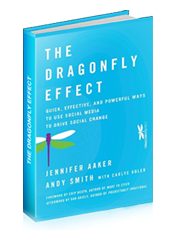
This book offers readers how to use social media in order to unleash unprecedented results for the benefit of society! My new year's resolution is to learn how to use blogging and tweeting as a way to practice writing more for enjoyment and self-expression, feeling that I don't feel when in my academic writing. But any form of writing must improve all forms of expression, so my thinking is that in this way social media is helping me to stretch my abilities and talents to a new level.
I'm really looking forward to reading The Dragonfly Effect! It is an important book that could offer some real practical tactics to exploiting this wonderful new medium of social media!
Saturday, January 1, 2011
Noise, Distraction Makes You Naughty...You Eat More!
One of my favorite theories to study is cognitive resource depletion, which says that your ability to resist temptations and focus your attention is limited and once you run out you aren't able to stop yourself from doing all sorts of naughty things.

A recent article on NPR reports on a study by Andy Woods at U. of Manchester which found that people who were distracted were less likely to distinguish sweetness and saltiness. Suzanne Higgs at U. of Birmingham found that when people were distracted during lunch they were more likely to eat more cookies later in the afternoon!
So why does distraction during eating make us eat more? It may be that distraction distorts the brain's ability to process perceptions of foods we are eating but that remains to be uncovered by more research. And yes that is indeed on my long to do list!

A recent article on NPR reports on a study by Andy Woods at U. of Manchester which found that people who were distracted were less likely to distinguish sweetness and saltiness. Suzanne Higgs at U. of Birmingham found that when people were distracted during lunch they were more likely to eat more cookies later in the afternoon!
So why does distraction during eating make us eat more? It may be that distraction distorts the brain's ability to process perceptions of foods we are eating but that remains to be uncovered by more research. And yes that is indeed on my long to do list!
Warding Off Bad Vibes with Images, Colors: An Experiment for Your Back To Work!

Today I've been contemplating going back to the office on Monday after a nice, productive holiday break. One thing I'm not looking forward to is the inevitable interrupting visit to my office of somebody with some bad news or information that I just don't want to be bothered with! We all suffer from these "Debbie Downers" at the office...they can upset, disturb, distract, and ruin a perfectly good day! But I was thinking back over the last few months since I moved into my new office and noticed that I've had significantly fewer annoying interruptions from bad personalities (the visits from people with great news and wonderful ideas has actually continued uninterrupted!) ever since I did one thing about a month after moving in...
I hung 4 two by three foot color images of flowers I photographed several years ago. They are posted throughout this blogpost!


Before I hung them, almost everyday I had some unusually sour tempered person come into my office and unload...either my research idea wasn't that great, or teaching this year will be impossibly hard, or my approval wasn't going to be granted on something. Oh, it was tough to keep going after getting sideswiped midday like that. But since those 4 images have gone up, all that has stopped...nothing but good news. People even come by just to talk about photography and almost everyone comments on the images when they walk in. Could these images and their hues of yellow, green and blue, prime people to behave differently?
While imagery in advertsing has been looked at quite extensively in the consumer behavior literature, there is a relatively new body of literature that is beginning to look at the effect of color. Mehta and Zhu from U. of British Columbia did a great paper in Science on the effect of red and blue on approach and avoidance behavior. I am collecting data next week that will hopefully build on these results trying to understand the effect of color on risk behavior.
So I have a challenge to you! Try this experiment in your office or home to see if it changes how people act when they come in. Download these images, print them out (in color of course) and place them in prominent view wherever you need a little protection from people with bad vibes. Observe whether there's any change! Let me know if you see a difference or not...I'd love to know whether this is really an effect I'm noticing or just random chance!!

Friday, December 31, 2010
Why Ballers Go Broke: Isn't $100M Enough to Be Set For Life? Apparently, Not For Some!

Browsing my old copies of Bloomberg Businessweek that had been piling up before the holiday break, I came across an interesting article by Paul Wachter entitled "Why Ballers Go Bust" (here's the online version). It centered on a question that I often wondered myself...how much is enough money to set you free...free to do what you want, work on what you want, break out of the hierarchy, tell people to kiss your butt? Well apparently, $100M+ is not enough...it seems that if you don't have what psychologists call self-regulatory capacity and if you don't have experience with the devastating curse of debt, then even hundreds of millions of dollars can't ensure that you will stay out of lawsuits, bankruptcy, and moving back in with your parents. Scottie Pippen earned and lost $120M, Evander Holyfield blew $200M..., and it wasn't just African American athletes who were susceptible. Lenny Dykstra "sold his World Series ring to pay creditors" and Mark Brunell lost millions in the real estate crash. Sports Illustrated puts the number at 60% of NBA players who are in financial problems 5 years after they retire.
It is surprising to me that millions of dollars are not enough to live independently...do you know how much 5% interest on $1M earns annually, and that doesn't even begin to add in the benefit of compounding...but I guess the adage of "it's all relative" and "money can't buy you love" may be true after all!
I dream of retirement, when my time will truly be my own and money will cease to be a concern but maybe the dream is a mirage...but I haven't given up looking for that ideal number of dollars that will buy me my dream day (e.g., wake up, write in my pajamas cup of java in hand, take my kids skiing, skating, traveling, dinner (preferably out) with my husband, sleep), everyday for the rest of my life...
Thursday, December 30, 2010
Gene Variant Puts You At Risk for Alzheimer's
MRI scans reveal brain changes in people at genetic risk for Alzheimer's
ScienceDaily (2010-12-30) -- People with a known, high risk for Alzheimer's disease develop abnormal brain function even before the appearance of telltale, amyloid plaques that are characteristic of Alzheimer's disease, according to a new study. The findings suggest that a gene variant affects brain function long before the brain begins accumulating the amyloid that will eventually lead to dementia. ... > read full article
Sniff Test for Dementia

As hard as it is to tell if you or someone you care about is developing or at risk for developing dementia or Alzheimer's, I always worry if my own absent-minded professor habits like forgetting my train of thought means that I am at risk for eventually developing such a disabling disease. After all, my grandfather and both my grandmothers died from Alzheimer's and my mother is currently battling early onset dementia at the age of 65. Interestingly, there is a simple test that I used on my own mom to test her a year ago when she became worried that she wasn't feeling quite normal.
A sniff test.
It turns out that the beta-amyloid plaques that Will eventually end up destroying brain cells throughout the brain seem to attack the brain areas involved in smell first. So the inability to identify common kitchen smells like coffee, cinnamon, lemon, and menthol (like from chest rub...) may indicate that dementia is likely in the future. This was from a study presented at the annual meeting of the American College of Neuropsychopharmacology. My mom didn't do spectacularly well on that test and our neuropsychologist a few months later confirmed with MRI scans what we already suspected. She had Alzheimer's - most likely a particular type called Alzheimer's with Lewy Bodies which has some similarities with Parkinson's disease in that it affects gait, posture and body control. A great paper from Johns Hopkins details more interesting insight on Alzheimer's detection!
Tuesday, December 28, 2010
I Can Beat That! - Putting A Human Face on Risk Changes Perception
Why do risks with human characteristics make powerful consumers feel lucky?
ScienceDaily (2010-12-23) -- People who feel powerful are more likely to believe they can beat cancer if it's described in human terms, according to new study. ... > read full article
Understanding Impulse Control...Depends on Who You Are
Unlocking the secrets of our compulsions
ScienceDaily (2010-12-20) -- Researchers have shed new light on dopamine's role in the brain's reward system, which could provide insight into impulse control problems associated with addiction and a number of psychiatric disorders. ... > read full article
Monday, December 27, 2010
Amygdala Size Key to How Social You Are
Structure deep within the brain may contribute to a rich, varied social life
ScienceDaily (2010-12-26) -- Scientists have discovered that the amygdala, a small almond shaped structure deep within the temporal lobe, is important to a rich and varied social life among humans. ... > read full article
Instinct in the Brain
Part of brain that suppresses instinct identified
ScienceDaily (2010-12-26) -- New research is revealing which regions in the brain fire up when we suppress an automatic behavior such as the urge to look at other people in an elevator. Researchers showed -- for the first time -- an increase in signal from the left inferior frontal cortex when study participants were confronted by a conflict between an image and a word superimposed on the image. ... > read full article
A Few Key Consumer Trends to Watch for 2011...
An article today in the Globe & Mail Report on Business Section listed some consumer trends to watch in 2011...A few of them I thought were especially interesting:
1. Urbanization: Every day 180,000 people move into cities around the world (I am a life long urbanite who only fantasizes about living off grid in the country)! People who live in cities tend to be more liberal (check), more likely to try out new products (check), and more tolerant (double check).
2. Owner-less society: Sorry Pres. Bush but the ownership society was a lousy, short-sighted idea that has thankfully gone by the wayside. Turns out that more and more consumers are happy to rent and/or share products, real estate, cars. Owning, especially when debt is required, is too onerous and burdensome as many of us have found! It has definitely been a trap for the baby-boomer generation - my parents dreamed of getting a credit card when they were broke and in their 20s and they are suffering under a mountain of consumer debt now that they are retired and in their 60s - me and my husband have previously felt the agony of a mortgage, 4 car leases, student loans, and business loans and have sworn ourselves to a life without debt - renting and sharing is the new way to consume that may finally work well for consumers!
3. Pursue big ideas! I like that! But how do you know your idea is big...I'm still working on that!
1. Urbanization: Every day 180,000 people move into cities around the world (I am a life long urbanite who only fantasizes about living off grid in the country)! People who live in cities tend to be more liberal (check), more likely to try out new products (check), and more tolerant (double check).
2. Owner-less society: Sorry Pres. Bush but the ownership society was a lousy, short-sighted idea that has thankfully gone by the wayside. Turns out that more and more consumers are happy to rent and/or share products, real estate, cars. Owning, especially when debt is required, is too onerous and burdensome as many of us have found! It has definitely been a trap for the baby-boomer generation - my parents dreamed of getting a credit card when they were broke and in their 20s and they are suffering under a mountain of consumer debt now that they are retired and in their 60s - me and my husband have previously felt the agony of a mortgage, 4 car leases, student loans, and business loans and have sworn ourselves to a life without debt - renting and sharing is the new way to consume that may finally work well for consumers!
3. Pursue big ideas! I like that! But how do you know your idea is big...I'm still working on that!
Friday, December 17, 2010
Ads Work Better If All Senses Are Involved
Taste Sensation: Ads Work Better If All Senses Are Involved
ScienceDaily (2009-07-22) -- Corporations spend billions of dollars each year on food advertising. For example, Kraft Foods, PepsiCo, and McDonald's each spent more than $1 billion in advertising in 2007. A new study suggests those advertisers are missing out if their ads only mention taste and ignore our other senses. ... > read full article
The Taste Gene -- Psychobiologists Find Genetic Component in Children's Food Preference
ScienceDaily () -- In the first study to link taste genes to behavior in children, researchers looked at how natural variations in a recently discovered taste gene affected sensitivity to bitter tastes and food preferences in a group of children and adults. Collecting genetic samples from 143 children and their mothers, the researchers showed moms and kids who had at least one bitter-sensitive region in the gene were generally able to detect even a hint of bitter flavor in a test drink. The same group of children, carrying one or two bitter-sensitive regions of a gene, also preferred higher concentrations of sucrose solutions and had stronger preferences for sweet-tasting food and beverages than did the bitter-insensitive kids.
Friday, December 10, 2010
Liberals and Conservatives Don't See Eyes The Same
Politics and eye movement: Liberals focus their attention on 'gaze cues' much differently than conservatives do
ScienceDaily (2010-12-09) -- It goes without saying that conservatives and liberals don't see the world in the same way. Now, research suggests that is exactly -- and quite literally -- the case. In a new study, researchers measured both liberals' and conservatives' reaction to "gaze cues" -- a person's tendency to shift attention in a direction consistent with another person's eye movements. Liberals responded strongly to the prompts, consistently moving their attention in the direction suggested to them by a face on a computer screen. Conservatives, on the other hand, did not. ... > read full article
Princess Stories: Do girls (and boys) need new tales?
Today Globe and Mail ran a story on Disney's princess franchise, which I was interviewed for. It brought up an interesting dilemma that Disney is facing: how do they continue to exploit the princess myth which my daughter and millions of girls around the world absolutely relish, while keeping up with the changing ethos of girls and women and challenging the criticism that neo-femininists lobe on whether these models should be marketed at all! Having both a son and a daughter I not only question the values promoted in princess stories but also the ones permeating boy coming of age stories too! Is it time for a completely new set of myths and archetypes for new generations of children who need better tools to help them survive in the future. Instead of "the knight in shining armor will save you from evil" how about "self-control over the impulses that can drive bad choices is the key to triumph." Instead of "kill or be killed" how about "avoid being one of the crowd; find what makes you special in what makes you so different and you will go beyond the crowd." The Grimm fairytales were written over 100 years ago...time for new tales to be written?
Friday, December 3, 2010
Aging is More Than Wrinkles...Your Jawline Actually Shifts!

Facial aging is more than skin deep
ScienceDaily (2010-04-19) -- Facelifts and other wrinkle-reducing procedures have long been sought by people wanting to ward off the signs of aging, but new research suggests that it takes more than tightening loose skin to restore a youthful look. A new study indicates that significant changes in facial bones -- particularly the jaw bone -- occur as people age and contribute to an aging appearance. ... > read full article
Monday, November 1, 2010
Torturing Shoppers with Chicken Wire: How Retailers Uses Data to Increase Impulsive Buying
Did you know that the first supermarket was the King Piggly Wiggly in Memphis, TN used chicken wire to herd shoppers through all the aisles in order to be sure that they saw every item in the store. This little tidbit fact I discovered this morning reading my Globe and Mail newspaper. The article written by Michael Kesterton went on to report that stores like Walmart use data collected on consumers via scanner registers, radio frequency tagging, etc. to manipulate the retail environment in order to maximize consumer sales especially impulse purchases. My mother who worked in sales for Estee Lauder for 35 years talked about how they would use flashing lights, blaring music, distracting displays (full of flowers, banners, people, colors, etc.)to bewilder and overstimulate consumers. All of this works in my opinion because of what cognitive resource depletion theory states is our limited ability to resist distraction and temptation and the rampant impulsivity and risky behavior that follows depletion. Ever wonder why you feel sooo exhausted and traumatized when shopping in the monster box stores (especially exacerbated when small kids are in tow)? The previously mentioned large retailer allegedly has a database of behavioral information that is 2nd only to the Pentagon...amazing! People don't need to fear government...large corporations are scarier! The retail experience needs innovation and renovation...the consumer should be helped not harangued!
Thursday, October 28, 2010
Addictions 2010 Conference in DC
This weekend I am making the long road trip (I got unceremoniously bumped from Delta flight) down to Arlington, VA for the Addictions 2010 Conference. This conference is focused on bridging research and public policy in treating and diagnosing addiction. To me this is an extremely important issue. The speaker list is great: H.W. Clark, U.S. Department of Health and Human Services, R. Morrison, National Association of State Alcohol & Drug Abuse Directors,H. Perl, National Institute of Drug Abuse and many academics doing work in this area! I will probably be the only consumer behavior researcher there...alas! Should be an eye opening weekend!
Tuesday, October 26, 2010
What Drives Hoarding Consumption? - Is It At Epidemic Levels?!
Every day I receive email alerts of news reports of extreme and dire cases of hoarding behavior. Animal hoarding is one form and maybe one of the more tragic since it impairs and debilitates both the human owner and the animals hoarded. But there are types of products hoarded and the problem is claimed to be at epidemic levels either because the public is only now being made aware of the problem lurking behind many barricaded and seemingly normal doorfronts or because there may be some underlying percipitating factor in modern society that is triggering the compulsive consumption behavior. My belief is that as a comsumer behavior researcher, this is one type of consumer behavior that demands much more research!!
The Biological Basis of Business Behavior
A recent article in the Economist discusses research that combines biology, psychology, endocrinology, and genetics to better understand business behavior such as risk perception, trust, and innovation. A colleague at Ivey, Rod White, for example published a paper with co-authors Stewart Thornhill and Elizabeth Hampson which found that men with higher levels of salival testosterone were more likely to be entrepreneurs. A really important area where this type of research could be applied is ethical behavior (see my recent blog post on the neural differences of psychopaths from the general population and possible links to management behavior), leadership and consumer innovators or trend leaders.
Monday, October 25, 2010
Looking for Experimental Stimuli: Use Images from Wikimedia Commons

I use tons (I mean thousands+) of images and ads as stimuli in my consumer behavior experiments. For the most part I spend a lot of time wading through stacks of old magazines that I collect in my office, ripping out ads and scanning them in for potential manipulation in Photoshop (by my helpful and talented technologist husband!!). This of course takes a lot of time!!
A good colleague of mine at Stanford directed me to a great resource for images that are royalty free at Wikimedia Commons. This is a great place to get an image of a brain, a camera or a smiling face...everything a researcher could want!! Thanks to those who allow their images to be used without the expectation of compensation!!
Image Source: Jal2001, Wikimedia Commons
Consumer Debt Sinking Seniors

I find it ironic that my parents' generation, the one who railed against the "establishment" and scoffed at their parents' frugality and conservatism, are now the ones suffering so terribly under the weight of extreme debt. An article today in USA Today states that older consumers have 50% more debt than younger ones and over 2/3 of older consumers who have filed for bankruptcy say that credit card debt was the major problem. It has been reported that most people file bankruptcy because of medical debt, but I don't think that is entirely true. I think the rampant, largely unregulated marketing of debt products, including credit cards, reverse mortgages (WTF is that good for????), student loans and other completely usesless manipulations of the financial industry have duped the older generation who during their young adulthood didn't spend a lot of time working on their self-control skills (just put the LSD down!). Now the pain of overconsumption is settling in on people who should be in their golden years...how do we help consumers who lack the ability (for whatever reason - e.g., does heavy partying and drug use during your younger years contribute to the inability to control compulsive behavior later in life? A research question for sure!!) to self-regulate and control compulsive behavior?
Image Credit: Lotus Head from Johannesburg, Gauteng, South Africa
Saturday, October 23, 2010
Setting Neurostandards?
The Advertising Research Foundation recently held a conference in NYC on setting standards for testing advertising using neuroscience tools such as fMRI and EEG. Participant research firms included Innerscope, Mindlab International, MSW/LAB, Neurocompass, NeuroInsight, Neurosense, Sands Research, and Sensory Logic. These companies represent a new wave of firms moving into this still controversial field of consumer neuroscience. Hopefully a communication between neuroeconomics researchers and practitioners in this field will result!
Are Some Business Executives Really Psychopaths?
An article today in Globe and Mail discussed how new brain imaging research is revealing more details on what makes some people psychopaths. It's thought that about 1% of the population is psychopathic and that criminals may be suffering from brain disfunction stemming from the disorder. The article also stated that the behaviors that are characteristic of psychopathy - manipulation, cunning, lack of empathy, inability to feel true emotion - may, in its functional form, also be the hallmark of CEOs and business executives. The disorder seems to stem from an abnormal structure of the amygdala - the brain structure responsible for processing fear - and the corpus callosum - which transfer neural information between the brain hemispheres. Interestingly, the corpus callosum is supposed to be more developed in women and those individuals with better social and emotional intelligence. An interesting question is whether these neural abnormalities could predict unethical behavior in business, think financial meltdown, and whether we are teaching and promoting the right set of skills in business schools where young people could be trained to counteract behavioral and cognitive deficiencies.
Transformative Consumer Research Conference June, 2011
The next Transformative Consumer Research conference will be held at Baylor University by my colleagues Brennan Davis and Connie Pechmann. The sessions sounds extremely interesting: Addiction, Risk and Young People, Poverty, Materialism. The crowd at the last TCR conference held at Villanova was an amazing group and the resulting JPPM article and book chapters in a new TCR book made attending well worth it. These are critical issues that consumer behavior researchers need to devote time and energy to understanding if marketing is to change its poor reputation! Consumers are suffering in many ways and research needs to discover the why and how in order to make consumers' lives better! The application deadline for the TCR conference is January 10, 2011.
Using Mturk for Experiments
Dan Goldstein at London Business School recently posted a great piece on using Amazon's Mturk to recruit participants for online experiments! One of the biggest impediments to getting research done is finding subjects to participate in studies...UC Irvine just recently put a limit on how many subjects could be recruited per study per semester...I collected data from 1600 subjects for my dissertation. A limit of 200 subjects really puts the breaks of data collection. If Mturk can offer access to potential participants, with a broader range of demographics (they aren't necessarily college students) for a realtively low cost (pennies per question per subject), then this could be a huge boon to researchers! We will be testing out Mturk in an upcoming study to see how running an experimental design works and whether there is any significant difference from our lab subject pool participants!
Wednesday, September 15, 2010
Color Processed by the Brain - Color Perception May Be Universally Similar!
Color Perception Is Not In The Eye Of The Beholder: It's In The Brain
ScienceDaily (2005-10-26) -- First-ever images of living human retinas have yielded a surprise about how we perceive our world. Researchers at the University of Rochester have found that the number of color-sensitive cones in the human retina differs dramatically among people -- by up to 40 times -- yet people appear to perceive colors the same way. The findings strongly suggest that our perception of color is controlled much more by our brains than by our eyes. ... > read full article
Friday, August 6, 2010
Virtual fMRI at UPenn
This link has videos so that you can see what being in an fMRI study is like. This is great for acquainting potential subjects to the special conditions in the scanner before your spend valuable time on pre-screening them.
Tuesday, July 27, 2010
Striatum and the Pleasure of Gains
Monetary gain and high-risk tactics stimulate activity in the brain
ScienceDaily (2009-11-17) -- Monetary gain stimulates activity in the brain, Japanese researchers report. Even the mere possibility of receiving a reward is known to activate an area of the brain called the striatum. ... > read full article
Predicting Behavior Better Than You Do!
Neuroscientists can predict your behavior better than you can
ScienceDaily (2010-06-23) -- In a study with implications for the advertising industry and public health organizations, neuroscientists have shown they can use brain scanning to predict whether people will use sunscreen in the next week better than the people themselves can predict whether they will do so. This is the first persuasion study in neuroscience to predict behavior change. ... > read full article
Monday, July 26, 2010
Loud Music Makes You Drink More? Would it Make You Buy More?
Loud Music Can Make You Drink More, In Less Time, In A Bar
ScienceDaily (2008-07-21) -- Commercial venues are very aware of the effects that the environment -- in this case, music -- can have on in-store traffic flow, sales volumes, product choices and consumer time spent in the immediate vicinity. A study of the effects of music levels on drinking in a bar setting has found that loud music leads to more drinking in less time. ... > read full article
Can Genes Drive Addictive Tendencies?

Can I buy you a drink? Genetics may determine sensitivity to other people's drinking behavior
ScienceDaily (2010-07-23) -- Your friend walks into a bar to meet you for happy hour. He sidles up to the bar and orders a drink -- does that make you more likely to get a drink yourself? According to new findings, genetics may determine the extent to which you are influenced by social drinking cues -- signals such as advertisements, drinks placed on a bar, and seeing other people around you drinking. ... > read full article
Tuesday, July 20, 2010
Wednesday, July 14, 2010
Smoking Craving Habit Not Addiction?
Smoking mind over smoking matter: Surprising new study shows cigarette cravings result from habit, not addiction
ScienceDaily (2010-07-13) -- The intensity of cravings for cigarettes has more to do with the psychosocial element of smoking than with the physiological effects of nicotine as an addictive chemical, according to a new study by an Israeli scientist. He hopes this research will help clinicians and health authorities develop more successful smoking cessation programs than those utilizing expensive nicotine patches or gum. ... > read full article
Monday, July 12, 2010
Baby's Brains Show Evolutionary Path
Baby brain growth mirrors changes from apes to humans
ScienceDaily (2010-07-13) -- A study undertaken to help scientists concerned with abnormal brain development in premature babies has serendipitously revealed evolution's imprint on the human brain. Scientists found that the human brain regions that grow the most during infancy and childhood are nearly identical to the brain regions with the most changes when human brains are compared to those of apes and monkeys. ... > read full article
Thursday, July 8, 2010
A Solution for Treating Alzheimer's? Paro the Robotic Pup!
 Photo credit: Pittsburgh Post-Gazette, post-gazette.com
A robotic pet, designed to look like a baby seal and response sensors throughout its body, is being used as a therapeutic tool for Alzheimer's patients...Could this also offer therapy for children with Autism or other learning disabilities? Or help patients with PTSD or depression? Worth doing the research on! I would love to buy one of these for my ailing mom and test out the theory!!
See the videos!

Tuesday, July 6, 2010
Are Some in Psych Wards Not Really Insane?
This is an amazing case of a young woman who went temporarily insane (I know the feeling) from a brain infection...in this case it was correctly diagnosed and treated. But how many mental illness cases such as those with Alzheimer's (my mom included) could maybe be treated by imaging the brain tissue!! The amazing brain and its power over us!
She went mad for a month
Jan. 15: Susannah Cahalan says she inexplicably lost her mind for a short period of time and has not received a proper diagnosis. TODAY’s Meredith Vieira and NBC’s chief medical editor Dr. Nancy Snyderman talk to her about the medical mystery
She went mad for a month
Jan. 15: Susannah Cahalan says she inexplicably lost her mind for a short period of time and has not received a proper diagnosis. TODAY’s Meredith Vieira and NBC’s chief medical editor Dr. Nancy Snyderman talk to her about the medical mystery
Friday, May 21, 2010
Two Excellent Books That Discuss the Neural Differences Between Men and Women
Two books I highly recommend look at the academic literature that investigates the biological and neurological differences between men and women...amazing stuff and definitely an area that needs more consumer behavior research!!
Sex On The Brain by Deborah Blum
The Essential Difference: The Truth About the Male and Female Brain by Simon Baron-Cohen
Sex On The Brain by Deborah Blum
The Essential Difference: The Truth About the Male and Female Brain by Simon Baron-Cohen
Wednesday, May 19, 2010
How to Achieve a Goal
Asking 'why' instead of 'how' helps consumers achieve goals of saving money or losing weight
ScienceDaily (2010-05-19) -- People who become focused on how to achieve a goal may have a harder time achieving their aims than people who think abstractly about why they want to do something, according to a new study. ... > read full article
Tuesday, May 4, 2010


Thursday, April 29, 2010
The meaning of colors across cultures

This is chart shows how cultures perceive the meaning of colors...
it is interesting to to see where cultures agree on the meaning, for example the color black means evil, and where they diverege. It is argued in the literature that behavioral reactions to colors are learned and reinforced by culture. But the effects of color on behavior is still being debated. Does red make us more cautious, more error prone or more aggressive? Does blue make us more creative, more calm or more risk-seeking? Is our perception of color context specific? This is an area of study that I am currently investigating based on the debated findings of Mehta and Zhu 2009.
Tuesday, April 27, 2010
Is This Your Brain on Drugs? Imaging Allows A View In...
Researchers develop technique to visualize 'your brain on drugs'
ScienceDaily (2010-04-27) -- Researchers at the US Department of Energy have developed an imaging protocol that allows them to visualize the activity of the brain's reward circuitry in both normal individuals and those addicted to drugs. ... > read full article
Friday, January 22, 2010
From the Well Being List Serve...

Researchers say its official: TGIF, baby!
January 15, 2010 6:00 am
The Los Angeles Times
By: Shari Roan
People are happier and feel better on the weekends, according to new research. Now that may be obvious to you. Indeed, this is the type of study that we at Booster Shots call "one for the duh files." However, on closer examination, the study reveals some interesting observations about leisure time.
For example, everyone is happier on the weekend -- even people who love their jobs and no matter what type of profession one is in or how much one is paid. The study found that people love the freedom associated with weekends and even feel better physically. Perhaps the most surprising finding is that people say they feel more competent during the weekend than they do while at their day-to-day jobs.
Researchers based their findings on responses from 74 volunteers age 18 to 62. Participants monitored their experiences three times daily for 21 consecutive days using simple forms or pagers.
The study reinforces what is known as the "self-determination theory," which means that well-being is based on one's personal needs for autonomy, competence and social relationships. People can tap into those needs more readily on the weekend. Conversely, they may experience time pressures, work demands and unpleasant relationships while at work.
"Far from frivolous, the relatively unfettered time on weekends provides critical opportunities for bonding with others, exploring interests and relaxing -- basic psychological needs that people should be careful not to crowd out with overwork," the lead author of the study, Richard Ryan, from the University of Rochester, said in a news release. The study was published in the January issue of Journal of Social and Clinical Psychology.
The research reaffirms how important leisure time is to well-being. But, the authors note, it also shows that work really can be a bummer. "These results point to possibilities for improving wellness both through enhancing need satisfactions at work and providing more time for adults that is free from work," the authors wrote.
So, it's true. Down time is really up time. Enjoy your weekend. And if you're working, I'm truly sorry.
-- Shari Roan
Photo credit: Luis Sinco / Los Angeles Times
--------------------------------------------------------------------------------------------------------------------------------------------------------------
ISQOLS LISTSERVE: ISQOLS listserve is an electronic bulletin board established to help quality-of-life (QOL) researchers post messages and announcements that may be of interest to QOL researchers.
How to Subscribe to ISQOLS Listserve: All you need to do is send a message to isqols@vt.edu and indicate in the body of the message: SUBSCRIBE ISQOLS-LISTSERV.
How to Post Messages on ISQOLS Listserve: The listserve is moderated. This means to avoid SPAM, all messages have to be approved by the moderator. The moderator is Joe Sirgy. Send your message to Joe at sirgy@vt.edu or isqols@vt.edu. Address the message to ISQOLS Listserve Members, and the message will be posted on isqols listserve if it is found suitable and of interest to QOL researchers. It is that simple.
How to Unsubscribe to ISQOLS Listserve: If you don't want to receive any postings from isqols listserve, all you need to do is send a message to isqols@vt.edu and indicate in the body of the message: UNSUBSCRIBE ISQOLS-LISTSERV.
ISQOLS Listserve Archive: To access ISQOLS Listserve Archive visit the following website: http://listserv.vt.edu/archives/isqols-listserv.html
January 15, 2010 6:00 am
The Los Angeles Times
By: Shari Roan
People are happier and feel better on the weekends, according to new research. Now that may be obvious to you. Indeed, this is the type of study that we at Booster Shots call "one for the duh files." However, on closer examination, the study reveals some interesting observations about leisure time.
For example, everyone is happier on the weekend -- even people who love their jobs and no matter what type of profession one is in or how much one is paid. The study found that people love the freedom associated with weekends and even feel better physically. Perhaps the most surprising finding is that people say they feel more competent during the weekend than they do while at their day-to-day jobs.
Researchers based their findings on responses from 74 volunteers age 18 to 62. Participants monitored their experiences three times daily for 21 consecutive days using simple forms or pagers.
The study reinforces what is known as the "self-determination theory," which means that well-being is based on one's personal needs for autonomy, competence and social relationships. People can tap into those needs more readily on the weekend. Conversely, they may experience time pressures, work demands and unpleasant relationships while at work.
"Far from frivolous, the relatively unfettered time on weekends provides critical opportunities for bonding with others, exploring interests and relaxing -- basic psychological needs that people should be careful not to crowd out with overwork," the lead author of the study, Richard Ryan, from the University of Rochester, said in a news release. The study was published in the January issue of Journal of Social and Clinical Psychology.
The research reaffirms how important leisure time is to well-being. But, the authors note, it also shows that work really can be a bummer. "These results point to possibilities for improving wellness both through enhancing need satisfactions at work and providing more time for adults that is free from work," the authors wrote.
So, it's true. Down time is really up time. Enjoy your weekend. And if you're working, I'm truly sorry.
-- Shari Roan
Photo credit: Luis Sinco / Los Angeles Times
--------------------------------------------------------------------------------------------------------------------------------------------------------------
ISQOLS LISTSERVE: ISQOLS listserve is an electronic bulletin board established to help quality-of-life (QOL) researchers post messages and announcements that may be of interest to QOL researchers.
How to Subscribe to ISQOLS Listserve: All you need to do is send a message to isqols@vt.edu and indicate in the body of the message: SUBSCRIBE ISQOLS-LISTSERV.
How to Post Messages on ISQOLS Listserve: The listserve is moderated. This means to avoid SPAM, all messages have to be approved by the moderator. The moderator is Joe Sirgy. Send your message to Joe at sirgy@vt.edu or isqols@vt.edu. Address the message to ISQOLS Listserve Members, and the message will be posted on isqols listserve if it is found suitable and of interest to QOL researchers. It is that simple.
How to Unsubscribe to ISQOLS Listserve: If you don't want to receive any postings from isqols listserve, all you need to do is send a message to isqols@vt.edu and indicate in the body of the message: UNSUBSCRIBE ISQOLS-LISTSERV.
ISQOLS Listserve Archive: To access ISQOLS Listserve Archive visit the following website: http://listserv.vt.edu/archives/isqols-listserv.html
Wednesday, December 30, 2009
Attention in the Brain
Seeing without looking: Brain structure crucial for moving the mind's spotlight
ScienceDaily (2009-12-29) -- Like a spotlight that illuminates an otherwise dark scene, attention brings to mind specific details of our environment while shutting others out. A new study shows that the superior colliculus, a brain structure that primarily had been known for its role in the control of eye and head movements, is crucial for moving the mind's spotlight. ... > read full article
Monday, December 28, 2009
Eating when not hungry?
Why some continue to eat when full: Researchers find clues
ScienceDaily (2009-12-28) -- New research in mice suggest that ghrelin might also work in the brain to make some people keep eating "pleasurable" foods when they're already full. ... > read full article
Thursday, November 12, 2009
Smoking levels have leveled off...but rates among poor, southerners, and less educated still high!
This is a report on the most recent data on smoking levels in the U.S. Notice that smoking amoung Southerners is still high and the rates are higher among young people and those with only a high school education. Is there a connection between self-control, addictive behaviors, and low levels of life success? How is the brain connected to all of this?
Wednesday, September 30, 2009
Negative Works Better....In Subliminal Advertising!
Key To Subliminal Messaging Is To Keep It Negative, Study Shows
ScienceDaily (2009-09-30) -- Subliminal messaging is most effective when the message being conveyed is negative, according to new research. ... > read full article
Sunday, September 20, 2009
Fat Molecules and the Brain
Ice Cream May Target The Brain Before Your Hips, Study Suggests
ScienceDaily (2009-09-19) -- Blame your brain for sabotaging your efforts to get back on track after splurging on an extra scoop of ice cream or that second burger during Friday night's football game. ... > read full article
You Won't Believe This! Fat Molecules in Ice Cream Make You Want More...For Up to 3 Days!
It seems fat molecules found in butter, cheese, beef and ice cream can affect the brain and turn off your feeling of being satisfied...for up to 3 days!
Here's the academic study!
Thanks to Prof. Marion Moore at Darden School of Business, University of Virginia for the links!!
Friday, September 11, 2009
Stars of Learning...in the Brain That Is!

Star-shaped Cells In Brain Help With Learning
ScienceDaily (2009-09-11) -- Every movement and every thought requires the passing of specific information between networks of nerve cells. To improve a skill or to learn something new entails more efficient or a greater number of cell contacts. Scientists can now show that certain cells in the brain -- the astrocytes -- actively influence this information exchange. ... > read full article
Friday, September 4, 2009
Happiness Trumps Sadness!
Brain Detects Happiness More Quickly Than Sadness
ScienceDaily (2009-06-21) -- People make value judgments about others based on their facial expressions. A new study shows that -- after looking at a face for only 100 milliseconds -- we can detect expressions of happiness and surprise faster than those of sadness or fear. ... > read full article
Friday, August 21, 2009
Recent Consumer Behavior Paper on Blue and Red Effects on Cognitive Tasks
Blue or Red? Exploring the Effect of Color on Cognitive Task Performances
Ravi Mehta and Rui (Juliet) Zhu*
Existing research reports inconsistent findings with regard to the effect of color on cognitive task performances. Some research suggests that blue or green leads to better performances than red; other studies record the opposite. Current work reconciles this discrepancy. We demonstrate that red (versus blue) color induces primarily an avoidance (versus approach) motivation (study 1, n = 69) and that red enhances performance on a detail-oriented task, whereas blue enhances performance on a creative task (studies 2 and 3, n = 208 and 118). Further, we replicate these results in the domains of product design (study 4, n = 42) and persuasive message evaluation (study 5, n = 161) and show that these effects occur outside of individuals' consciousness (study 6, n = 68). We also provide process evidence suggesting that the activation of alternative motivations mediates the effect of color on cognitive task performances.
Ravi Mehta and Rui (Juliet) Zhu*
Existing research reports inconsistent findings with regard to the effect of color on cognitive task performances. Some research suggests that blue or green leads to better performances than red; other studies record the opposite. Current work reconciles this discrepancy. We demonstrate that red (versus blue) color induces primarily an avoidance (versus approach) motivation (study 1, n = 69) and that red enhances performance on a detail-oriented task, whereas blue enhances performance on a creative task (studies 2 and 3, n = 208 and 118). Further, we replicate these results in the domains of product design (study 4, n = 42) and persuasive message evaluation (study 5, n = 161) and show that these effects occur outside of individuals' consciousness (study 6, n = 68). We also provide process evidence suggesting that the activation of alternative motivations mediates the effect of color on cognitive task performances.
More on Red
Red Enhances Men's Attraction To Women, Psychological Study Reveals
ScienceDaily (2008-10-28) -- Psychologists have added color -- literally and figuratively -- to the age-old question of what attracts men to women. Psychologists have demonstrated that the color red makes men feel more amorous toward women. And men are unaware of the role the color plays in their attraction. ... > read full article
The Color Red - More
Research On The Color Red Shows Definite Impact On Achievement
ScienceDaily (2007-03-01) -- The color red can affect how people function: Red means danger and commands us to stop in traffic. Researchers at the University of Rochester have now found that red also can keep us from performing our best on tests. ... > read full article
Color Red Bias
Red All Over: How The Color Red Affects A Referee's Judgment
ScienceDaily (2008-08-10) -- A new study has found that choosing the color red for a uniform in competitive sports can actually affect the referee's split-second decision-making ability and even promote a scoring bias. ... > read full article
Sunday, July 5, 2009
Monday, June 29, 2009
Assymetry in Distribution of Single Men and Women...Why?
A little off my usual post but interesting nonetheless, Prof. Dan Goldstein, London School of Economics, blogs at "Decision Science News" and today he featured an interesting mapping website called www.whosyourcity.com. One of the maps showed that the ratio of single men to single women is higher on the West Coast and lower on the East Coast.
The pivotal question Dan asks is what explains this disparity? I'm thinking it might be due to the ratio of ethnic groups such as African Americans where women dominate in numbers and many males are incarcerated or outside the traditional system (homeless, transient, illegal activity) and less likely to participate in a census. Just my guess!
The pivotal question Dan asks is what explains this disparity? I'm thinking it might be due to the ratio of ethnic groups such as African Americans where women dominate in numbers and many males are incarcerated or outside the traditional system (homeless, transient, illegal activity) and less likely to participate in a census. Just my guess!
Friday, May 15, 2009
Trial and Error Works! Past Experience Changes Neural Circuitry

Past Experience Is Invaluable For Complex Decision Making, Brain Research Shows
ScienceDaily (2009-05-15) -- Researchers have shown that past experience really does help when we have to make complex decisions based on uncertain or confusing information. They show that learning from experience actually changes the circuitry in our brains so that we can quickly categorize what we are seeing and make a decision or carry out appropriate actions. ... > read full article
Tuesday, April 28, 2009
IQ Linked to Better Financial Decisions

People With Higher IQs Make Wiser Economic Choices, Study Finds
ScienceDaily (2009-04-28) -- People with higher measures of cognitive ability are more likely to make good choices in several different types of economic decisions, according to a new study. ... > read full article
Thursday, April 9, 2009
Jet Lag a Myth?

Since I live with sleep deprivation, I have always wondered, given the severe effect on my cognitive and emtional judgement my lack of sleep causes, how it impacts consumer psychology. This latest post by my esteemed colleague Dan Goldstein at London B School states the case for why jet lag may not exist and that the effect people feel when they travel across time zones is actually sleep deprivation. See more here!
Sunday, April 5, 2009
Thursday, April 2, 2009
Color and Behavior!!!
Red Enhances Men's Attraction To Women, Psychological Study Reveals
ScienceDaily (2008-10-28) -- Psychologists have added color -- literally and figuratively -- to the age-old question of what attracts men to women. Psychologists have demonstrated that the color red makes men feel more amorous toward women. And men are unaware of the role the color plays in their attraction. ... > read full article
Tuesday, March 3, 2009
The Eyes Have It: Face Recognition In 2 Points - Just Left and Center of the Nose
The Nose Knows: Two Fixation Points Needed For Face Recognition
ScienceDaily (2008-10-21) -- Many of us are bad at remembering names but we are very quick to point out that at least we never forget a face. Never mind recognizing a familiar face -- how is it that we recognize faces at all? ... > read full article
Thursday, February 19, 2009
Attention and Brand Location
DVR Fast-forwarding May Not Be Fatal To TV Advertising
ScienceDaily (2008-11-21) -- With the advent of digital video recorders and products like TiVo, viewers can fast-forward past commercials while playing back their favorite shows. Researchers found that viewers can retain valuable brand information even from an ad glimpsed for a fraction of its actual length. However, they also found that ads with brand information located on the periphery of the TV screen are of virtually no value. ... > read full article
Saturday, February 14, 2009
Financial risk behavior shown in men with higher testosterone levels!
ScienceDaily (2008-09-30) -- Two researchers from Harvard jointly led a recent study in which they showed that men with higher testosterone levels invest more money during a risky investment game. The study associates higher testosterone levels with financial risk-taking behavior. LINK
Risk taking gene isolated!
ScienceDaily (2009-02-11) -- A new study provides provocative insights that relate to the question of the day: "How in the world did so many financial titans take such huge risks with out nation's well being?" The new research pinpoints the roles specific variants of the serotonin transporter gene and the dopamine receptor gene play in predicting whether people are more or less likely to take financial risks. LINK
Material versus experiential gifts and happiness!
An experiential gift is better and more memorable than a material gift unless the experiential gift is negative. http://ucelinks.cdlib.org:8888/sfx_local?sid=google&auinit=M&aulast=Schulte-R%C3%BCther&atitle=Gender+differences+in+brain+networks+supporting+empathy&id=doi:10.1016/j.neuroimage.2008.04.180
Women's mirror neurons activate when looking at other's emotional faces but men's do not!
A recent paper (Shulte-Ruther et al. 2008) found that women, when evaluating the emotional expressions in faces, showed higher activation in right inferior frontal cortex where mirror neurons are believed to be, while men did not show this activation.
Thursday, February 5, 2009
Subscribe to:
Comments (Atom)